Latest Blog
Infection Control in Hospitals: The Role of Lighting
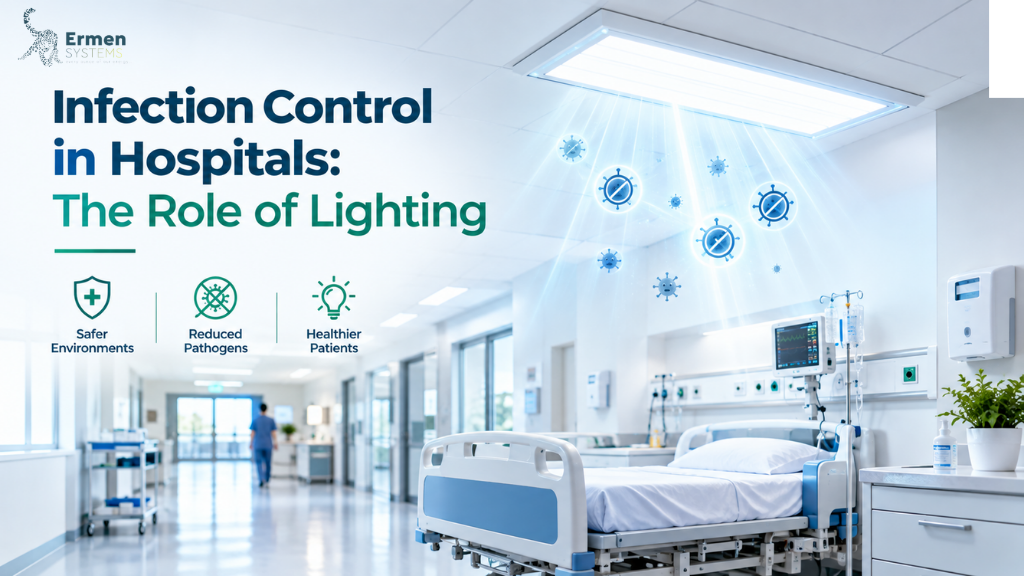
Lighting plays two useful roles in hospital infection control. Some lighting actively lowers germs on surfaces and in the air, using UV-C or safe visible light. Good general lighting also helps staff clean and work more accurately.
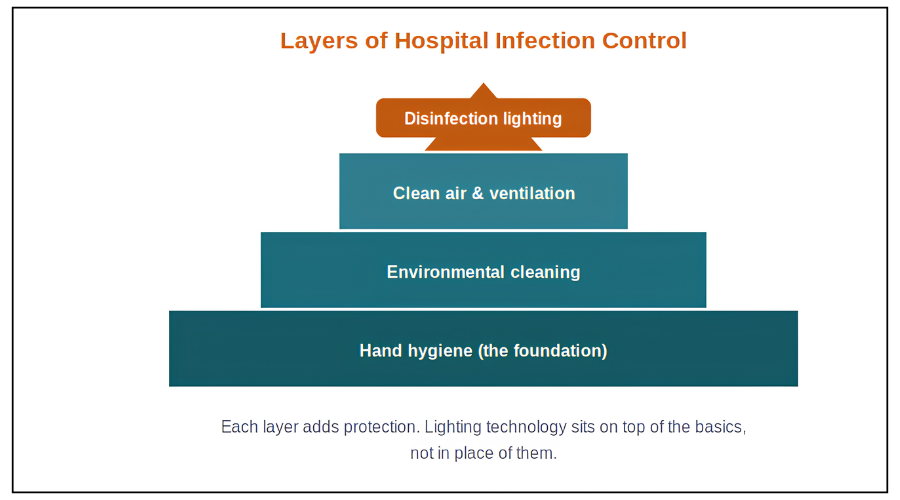
Lighting is not a complete answer on its own, and it should never be sold as one. It works as one layer within a wider programme that includes hand hygiene, cleaning, clean air and safe working habits.
This guide explains how hospital infection control works, and where lighting fits in a practical, everyday way. It is written for facility and estates teams who want a clear picture without the jargon.
Planning better infection control for your facility? Ask Ermen Systems about lighting that supports a cleaner site.
What is a healthcare-associated infection?
A healthcare-associated infection, or HAI, is an infection a patient picks up while receiving care, rather than one they came in with. Common examples include MRSA, C. difficile and surgical site infections.
These infections are a serious burden. Health bodies estimate that around one in fifteen hospital patients has an HAI at any given time, and millions of cases occur across Europe each year. Some involve germs that resist common antibiotics, which makes prevention even more important.
HAIs can lengthen a hospital stay, raise costs and put vulnerable patients at risk. That is why every hospital runs a structured infection control programme.
Germs spread through hands, shared surfaces and the air. Control works by breaking each of these routes, so the fewer chances a germ has to move, the safer the ward.
What does hospital infection control involve?
Infection control is a set of layers that work together. No single step does everything, so hospitals combine several and check them constantly.
-
Hand hygiene, the single most important step for staff and visitors.
-
Regular, thorough environmental cleaning of surfaces and equipment.
-
Clean air and good ventilation, especially in theatres and isolation rooms.
-
Isolation of patients with certain infections to stop spread.
-
Careful use of antibiotics to slow resistance.
On top of these basics, many hospitals add technology that lowers germs automatically. Disinfection lighting is one of these added layers.
The value of technology is that it keeps working even when the ward is short-staffed or very busy. It does not get tired or skip a step, so it gives a steady baseline of protection.
How can lighting reduce infections?
There are two main ways lighting helps cut the germ load in a hospital. They suit different situations, and many sites use both together for the best cover.
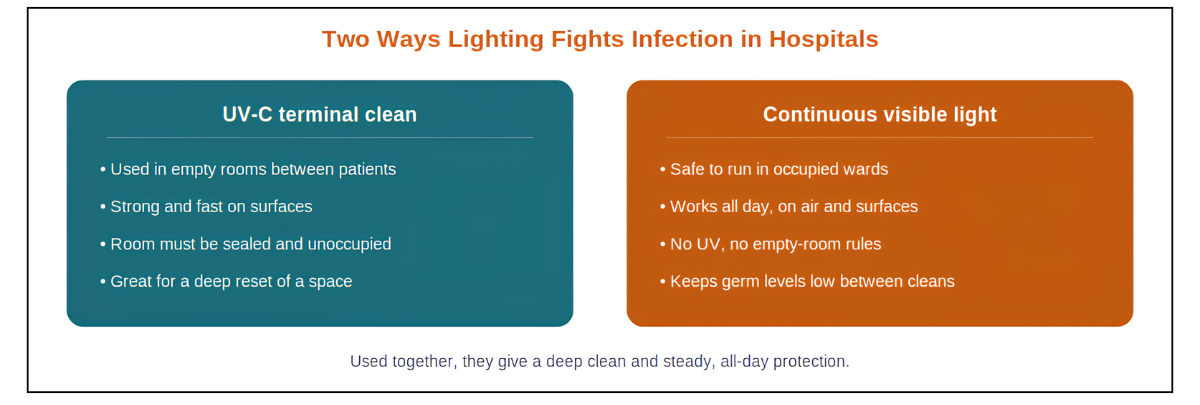
The first is a fast, deep clean of an empty room. The second is steady, all-day protection in rooms that stay busy. You can see how safe antibacterial lighting delivers the second role.
Both approaches target the same problem from different angles. One resets a room to a very low germ level, and the other stops that level creeping back up during the day.
It also helps to think about cost over time. Continuous lighting adds little to the electricity bill and needs little upkeep, while it quietly supports the cleaning team every hour of the day.
Want help choosing the right approach for your wards? Talk to our team for practical, no-pressure advice.
UV-C disinfection in hospitals
UV-C is a strong, invisible light used to clean rooms between patients. Mobile units or fixed fittings treat an empty room and cut pathogens on surfaces quickly, often in a matter of minutes.
It is very effective for a terminal clean, but it has clear limits. The room must be empty and sealed while it runs, and the light only treats surfaces it can reach directly, so shadowed areas are missed.
For this reason UV-C is best used as a periodic deep clean, not as constant protection while staff and patients are present.
In practice, a room is cleared, cleaned by hand, and then given a UV-C cycle to finish the job. It is a strong final step, but it needs planning around the ward’s schedule.
Continuous visible-light disinfection
Visible-light disinfection solves the problem of busy rooms, which is where most hospital care actually happens. It uses safe visible frequencies, so it can stay on all day while wards and theatres are in use.
It works more slowly than UV-C, but it never stops, keeping surface and air germ levels low between manual cleans. Because it is used near patients, look for devices with proper medical-device certification.
The main benefit is coverage of the hours that manual cleaning cannot reach. Between scheduled cleans, the light keeps chipping away at the germ load without any extra staff time.
Biovitae is one such system, certified as a medical device, and you can read about the technology behind it and the clinical lighting options available.
Why good general lighting also matters
Beyond active disinfection, ordinary lighting quality affects infection control more than people expect. It is an easy factor to overlook.
Well-lit rooms are cleaned better, because staff can see dirt and missed spots. A dim corner is an easy place for grime to hide. Bright, clear lighting also helps reduce errors during care and procedures.
Beyond active disinfection, ordinary lighting quality affects infection control more than people expect. It is an easy factor to overlook.
Well-lit rooms are cleaned better, because staff can see dirt and missed spots. A dim corner is an easy place for grime to hide. Bright, clear lighting also helps reduce errors during care and procedures.
Lighting can also support the day-and-night rhythm of patients and staff, which aids rest and recovery. So the right lighting helps in several quiet ways at once, from cleaning quality to comfort on the ward.
How do you add lighting to an infection control plan?
Adding disinfection lighting works best as a planned step, not a random purchase. A few simple questions guide the choice and keep the spend focused where it does the most good.
-
Which rooms can be emptied for a UV-C clean, and which cannot?
-
Where do patients and staff spend the most time together?
-
What does the current cleaning schedule leave uncovered?
-
Are the devices certified for use around people?
With those answers, you can place UV-C where rooms empty out and continuous visible light where they stay busy. This gives good cover without wasted spend, and it makes the case easy to explain to a board or budget holder.
Ready to strengthen infection control at your facility? Contact Ermen Systems for advice and a plan for your site.
Where does lighting fit across a hospital?
Different areas need different mixes of these tools, and a good plan matches each space to how it is actually used through the day.
Theatres and isolation rooms benefit from both terminal UV-C cleans and clean-air systems. Busy wards, corridors and waiting areas suit continuous visible light, which keeps working while people are present. Even a small step like better-lit sluice and store rooms can help. You can see how this fits real healthcare settings.
Air quality matters too. Pairing lighting with air and surface purification adds another layer, and air units for care settings bring the same thinking to nursing and residential homes.
Care homes face many of the same challenges as hospitals, often with fewer staff. Steady, automatic tools are especially useful there, since they keep working without extra hands.
The same ideas scale down to clinics, dental surgeries and GP practices too. Any space where sick people gather can gain from cleaner air, cleaner surfaces and better lighting.
Frequently Asked Questions
It can help. UV-C and continuous visible-light disinfection both lower germs on surfaces and in the air. They work as one part of a wider infection control programme.
Yes, widely. UV-C units clean empty rooms between patients. The room must be unoccupied while the light runs, as UV-C is unsafe for skin and eyes.
Yes. It uses safe visible light with no UV, so it can run in occupied rooms. For clinical use, choose devices with medical-device certification.
No. It supports cleaning and hand hygiene, it does not replace them. The basics remain the foundation of infection control.
Yes. Care and nursing homes face similar risks to hospitals, often with fewer staff, so automatic tools like clean air and disinfection lighting are a real help there.
Common HAIs include MRSA, C. difficile, surgical site infections, urinary infections linked to catheters and some chest infections.
Conclusion
Lighting can play an important supporting role in hospital infection control alongside cleaning, hand hygiene and good ventilation. UV-C can support disinfection in unoccupied rooms, while visible-light disinfection can provide continuous support in occupied areas. Ermen Systems provides lighting solutions such as Biovitae to help healthcare facilities create cleaner, safer environments and strengthen their overall infection control approach.
