
Latest Blog
How Much Can LED Lighting Save on Your Energy Bills?
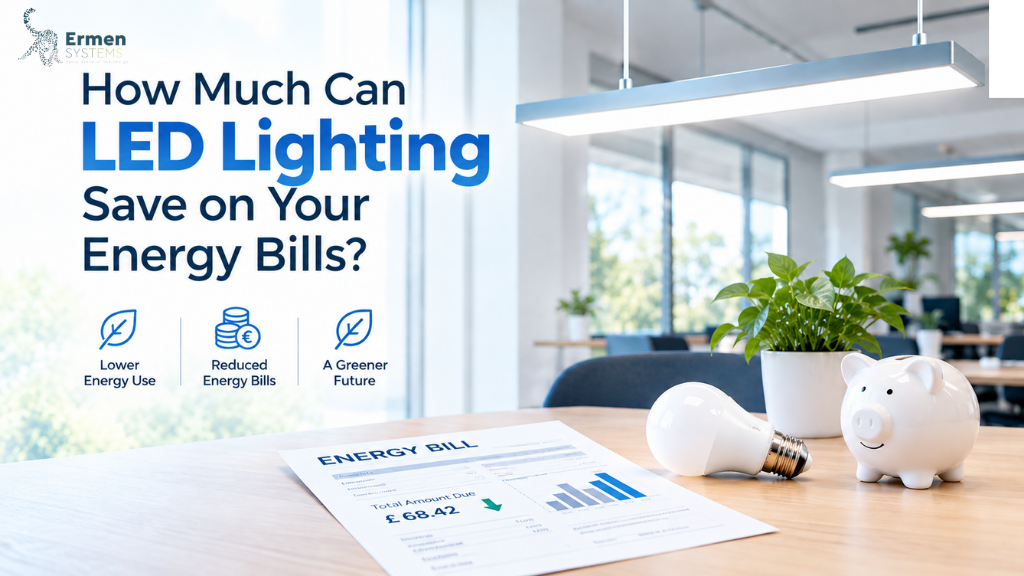
LED lighting can cut the electricity your lights use by around 80%. LEDs use far less power than old bulbs and last many times longer, so a full switch can noticeably lower a home bill and save a business thousands each year.
Your exact saving depends on three things: what bulbs you replace, how many hours your lights run, and the price you pay per unit of electricity. Get those right and the saving is easy to predict.
This guide shows the real numbers, with simple examples for Irish homes and businesses, so you can work out your own saving before you spend anything. It also covers how quickly LED pays for itself and how to get the biggest saving from a switch.
How much less energy does LED use?
This is where the saving starts. An LED gives the same brightness as an old bulb while using only a fraction of the power. Brightness is measured in lumens, and you can match it easily between old and new bulbs.
A traditional 60-watt incandescent bulb can be replaced by a 9-watt LED that puts out the same light. That is about 85% less power for the same job. Against halogen spotlights, LEDs often use 80% to 90% less.
Even against energy-saving CFL bulbs, a good LED still uses roughly 40% to 50% less power and lasts far longer.
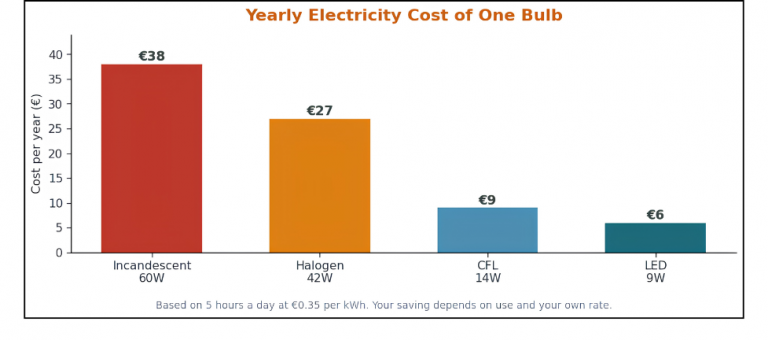
The reason is simple. Old bulbs waste most of their energy as heat, not light. LEDs turn far more of the power into light, so very little is lost. The chart below shows the yearly running cost of one bulb of each type.
Want to know how much your building could save? Ask Ermen Systems for a quick, honest estimate.
How much money can you actually save?
Let us put real figures on it. Electricity in Ireland is among the more costly in Europe, so the savings from cutting waste add up faster here than in many other countries.
Take one 60-watt bulb on for five hours a day. At about 0.35 euro per unit, it costs close to 38 euro a year to run. The 9-watt LED that replaces it costs under 6 euro a year. That is more than 30 euro saved from one bulb, every year, for very little effort.
Now scale that up. A home with 20 or 30 older bulbs can save well over 100 euro a year, and often much more if the lights run for long hours. Check your own rate on a recent bill to make the sum exact.
Businesses save on a bigger scale. An office or shop with a hundred lights running ten hours a day can cut hundreds of euro every month. Over a year, that often runs into thousands of euro saved.
What affects how much you save?
Two homes can buy the same LED bulbs and see very different savings. A few simple factors explain why, and knowing them helps you predict your own result.
-
Hours of use: a light on ten hours a day saves far more than one used briefly.
-
What you replace: swapping old incandescent or halogen bulbs saves the most.
-
Your electricity rate: the higher your unit price, the bigger the saving.
-
Number of lights: more fittings mean the totals add up faster.
-
Controls: sensors and dimmers stop you paying for light you do not need.
This is why it helps to look at your own home or building rather than a general figure. The same switch can save one office a few hundred euro and another several thousand.
Why LEDs save more than just electricity
The power saving is only part of the story. LEDs also last far longer than any older bulb, which saves you money in a second, quieter way.
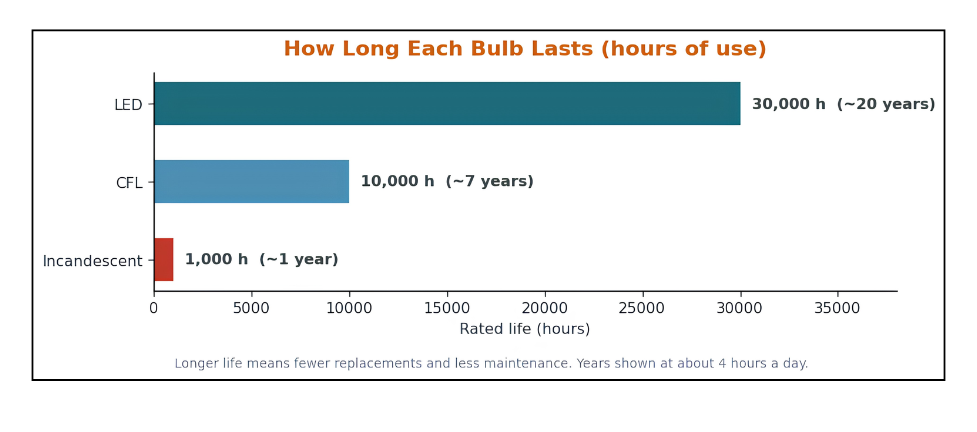
A typical LED runs for 20,000 to 30,000 hours or more. An old incandescent lasts about 1,000 hours, and a CFL around 10,000. So you buy fewer bulbs and spend less time replacing them. At normal home use, a single LED can last twenty years or more.
In a business, that means fewer call-outs to change lamps high up in a warehouse or office. Each change can mean hiring a lift or paying an electrician, so fewer replacements is a real, hidden saving.
LEDs also give off far less heat than old bulbs. In summer, that keeps rooms cooler and can trim air-conditioning costs, which is a small bonus on top of the lighting saving.
How long until LED lighting pays for itself?
LED bulbs cost a little more to buy than the cheapest old bulbs, but they earn that back quickly through lower bills.
For a home, a single LED bulb often pays for itself within a year through lower running costs. After that, the saving is money in your pocket for years, because the bulb keeps running long after it has paid for itself.
For a business, a full switch usually pays back in one to three years, depending on how long the lights run. Sites with lights on all day, such as shops, warehouses and car parks, see the fastest return. After payback, the saving drops straight to the bottom line. You can read more about the benefits of Airius LED lighting for larger buildings.
How to get the most savings from LED
A few simple choices help you squeeze out the biggest saving, on top of the basic bulb swap.
-
Replace the lights you use most first, such as the kitchen, office or shop floor.
-
Match the brightness to the room instead of buying a bulb that is too strong.
-
Pick the right colour of light: warm for living areas, cooler white for work areas.
-
Add sensors or timers so lights are not left on in empty rooms.Choose good-quality LEDs so they last the full life they promise.
-
Small steps like these can lift your saving well beyond the bulb swap alone. Sensors in corridors, toilets and store rooms are an easy win, since those lights are often left on by mistake.
Ready to lower your energy bills with LED? Contact Ermen Systems for advice and a quote.
LED savings for homes, businesses and public spaces
The bigger the lighting bill, the bigger the saving from LED. That is why the numbers look so different for a small flat and a large business.
In homes and offices, the saving is steady and welcome, especially with today’s electricity prices. For public and outdoor lighting, where lights burn for many hours, the yearly saving can be very large.
Councils and large sites that switch street and car-park lighting to LED often report some of the biggest yearly savings of all, simply because those lights run every night.
Heating and airflow play a part too. Pairing efficient lighting with destratification that cuts heating bills gives an even lower total energy bill across a building.
Can you save energy and get cleaner air together?
Yes. Some LED lights do a second job while they save you money, so you are not choosing between savings and hygiene.
Biovitae uses the same low-energy LED base as any modern light, but it also lowers germs in the room. So you get the energy-saving antibacterial lighting benefit and cleaner surfaces from one fitting. Browse the range of LED lights to compare options.
Frequently Asked Questions
LEDs use around 80% less electricity than old incandescent bulbs. A home can save over 100 euro a year, and a business can save thousands, depending on use.
Yes. An LED uses a fraction of the power of an old bulb for the same brightness, so it costs far less to run each year.
Most LEDs last 20,000 to 30,000 hours or more, which can be 20 years at normal home use. Old bulbs last about 1,000 hours.
Yes. LEDs give off much less heat than old bulbs, so rooms stay cooler and any air conditioning has less work to do.
For almost everyone, yes. With current electricity prices, the running-cost saving usually pays back the bulb price within a year or two.
Conclusion
LED lighting can help reduce energy use, lower electricity bills, and cut replacement costs over time. The exact savings depend on your lighting type, usage, and electricity rate. For homes and businesses, choosing the right LED solution can provide long-term energy and cost benefits. Ermen Systems can help you find an efficient lighting solution and estimate your potential savings.
