
Latest Blog
Ceiling-Mounted vs Wall-Mounted Single Room Heat Recovery Units: A Buyer’s Guide
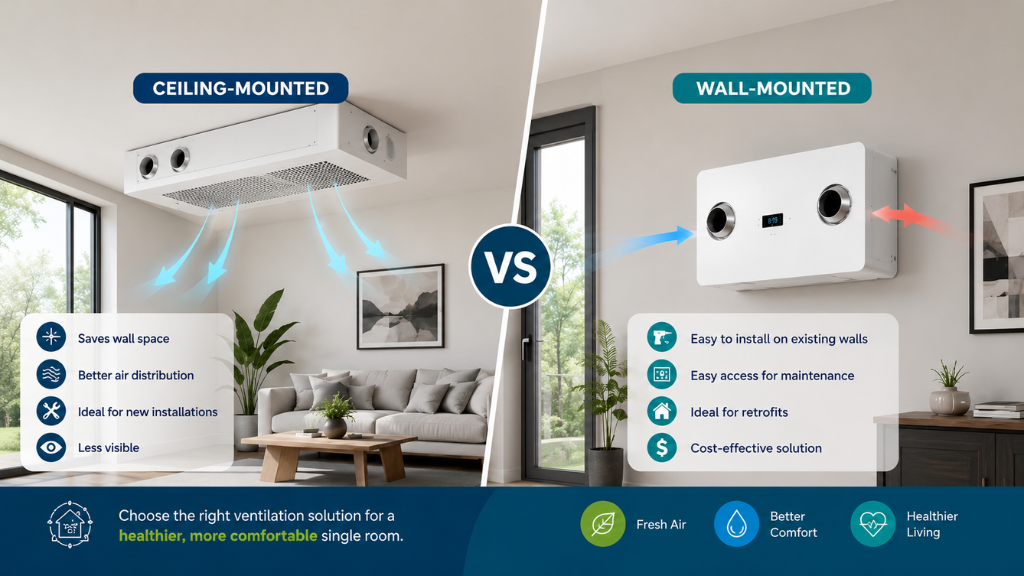
If you are trying to improve ventilation in one room without installing a whole-house system, a ceiling mounted single room heat recovery unit can be an attractive option. But ceiling installation is not automatically better than mounting a unit through an external wall.
The right choice depends on your room layout, external wall access, available space, installation requirements, and the type of ventilation problem you are trying to solve. For UK homeowners, this matters particularly in bedrooms, bathrooms, kitchens, and renovated properties where moisture and stale air can become difficult to manage.
This guide compares ceiling-mounted and wall-mounted options so you can choose a solution that fits your home, rather than simply choosing the unit with the most impressive specifications.
What Is A Single Room Heat Recovery Unit?
A single-room heat recovery unit provides continuous ventilation for an individual room or area. It removes stale, humid indoor air and introduces fresh outdoor air while recovering heat from the extracted air.
Unlike a central MVHR system, a decentralised unit does not normally require an extensive network of ducts throughout the property. This makes it particularly useful for existing UK homes, extensions, and renovation projects where installing ductwork could mean major disruption.
Modern single-room heat recovery units can include features such as humidity, temperature, and air-quality sensors. These features help the system respond to changing indoor conditions and maintain a steady supply of fresh air while recovering heat from the extracted air.
Ceiling-Mounted Vs Wall-Mounted: Essential Differences
Here is the important difference between ceiling-mounted and wall-mounted:
Why Do Homes Need Heat Recovery Ventilation?
| Factor | Ceiling-Mounted | Wall-Mounted |
|---|---|---|
| Space | Keeps wall space free | Requires suitable wall space |
| Installation | May need ceiling access and ducting | Often simpler through an external wall |
| Appearance | More discreet | More visible |
| Maintenance | Needs accessible ceiling access | Usually easier to reach |
| Best for | Renovations or rooms with limited wall space | Retrofit projects with an external wall |
Ermen Systems can help you choose the right single-room heat recovery solution for your space and ventilation needs.
Which Is Better For Your Home?
There is no universal winner. Your room and property should determine the installation position.
Choose Ceiling Mounting When:
A ceiling-mounted unit may be worth considering if:
- Wall space is already occupied by furniture, windows, or radiators.
- You want the ventilation equipment to be less visually prominent.
- Your renovation provides easy ceiling access.
- The room layout makes ceiling-level air distribution advantageous.
- An installer can provide a suitable route for the external connection.
A good example would be a renovated room where the ceiling is already being opened for electrical or building work. Combining installation tasks can reduce disruption.
Choose Wall Mounting When:
Wall mounting is often the logical choice when:
- You are retrofitting an existing property.
- An external wall is readily accessible.
- You want to minimise building work.
- There is limited access above the ceiling.
- You are targeting a specific problem room.
- You want a relatively straightforward installation.
This is one reason a single room heat recovery ventilator can be useful in older homes. Instead of redesigning the entire property’s ventilation system, you can address the room where condensation, humidity, or stale air is causing the biggest problem.
Think About The Room, Not Just The Mounting Position
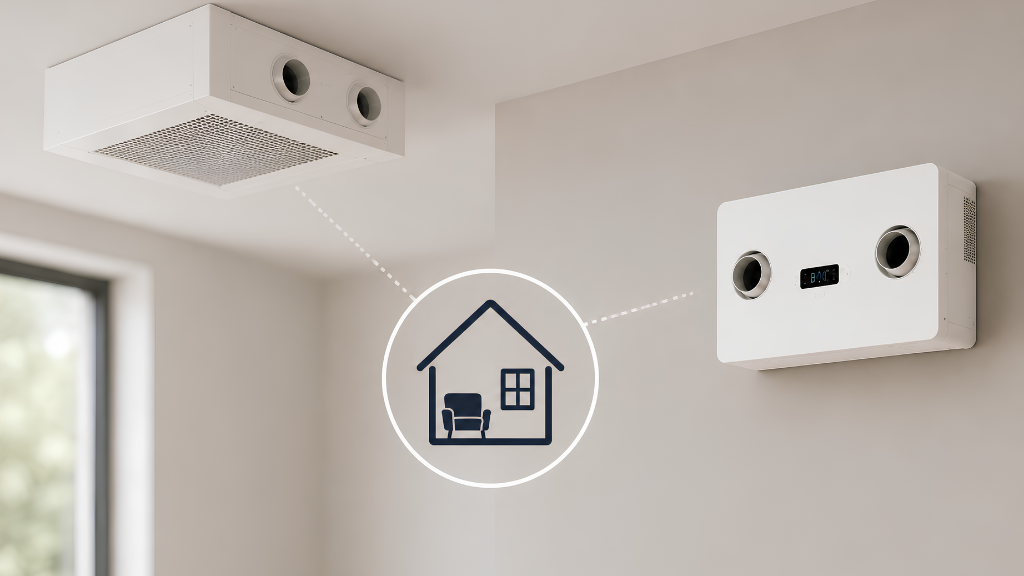
The best installation position depends on how the room is used.
A bedroom, for example, may need quiet continuous ventilation because occupants spend several hours there overnight. A bathroom has a different requirement because humidity can increase rapidly during showers.
Kitchen areas can also produce excessive moisture and odours, while living rooms may benefit from improved fresh-air circulation.
The unit should therefore be selected according to the room’s size, occupancy, airflow requirement, and ventilation problem, not simply because one mounting position looks easier.
What About Condensation And Mould?
Poor ventilation allows moisture from everyday activities such as cooking, showering, and drying clothes to remain indoors.
Over time, excessive humidity can contribute to condensation and create conditions where mould develops. This is especially relevant in modern, better-insulated homes where uncontrolled air leakage is reduced.
A properly selected single-room HRV continuously removes moisture-laden air while introducing fresh air. This can help manage humidity and support a more comfortable indoor environment.
For homeowners researching ways to Reduce Mould, ventilation should be considered alongside practical measures such as controlling moisture sources, heating appropriately, and addressing leaks or dampness.
Can You Start With One Room?
Yes. One of the major advantages of decentralised ventilation is that you can target specific rooms.
Suppose your home has persistent condensation in two upstairs bedrooms. Installing suitable units in those rooms may be more practical than immediately undertaking a whole-house ventilation installation.
Later, additional units can be considered if other areas require improved ventilation.
This targeted approach can be particularly useful during staged renovation projects, where homeowners want to improve indoor air quality without taking on a major building project at once.
If you are comparing Heat Recovery Systems with conventional extractor fans, remember that heat recovery ventilation is designed to provide ongoing air exchange while recovering warmth from outgoing air. That makes it particularly relevant where homeowners want ventilation without simply exhausting heated air outside.
Ceiling Or Wall: A Simple Decision Guide
Choose ceiling mounting when discreet positioning, limited wall space, and accessible ceiling construction make it practical.
Choose wall mounting when you are retrofitting an existing home and have a suitable external wall with minimal installation disruption.
If both options are possible, compare the total installation requirements rather than choosing based purely on appearance. The best system is the one that delivers appropriate airflow, manageable noise, accessible maintenance, and effective moisture control for the room.
Not sure which single-room heat recovery system is right for your home? Let Ermen Systems help you find the right solution.
Frequently Asked Questions
It ventilates one room by removing stale air and bringing in fresh air while recovering heat from the outgoing air.
Neither is always better. The right choice depends on your room layout, available space, and installation requirements.
Yes. By continuously removing moisture-laden air, it can help reduce excess humidity and condensation.
Noise levels vary by model and fan speed. Check the manufacturer’s sound rating before choosing a unit.
Final Thoughts
Choosing between ceiling and wall mounting comes down to your property, room layout, and installation constraints. A ceiling mounted single room heat recovery unit can be discreet and practical in the right setting, while wall-mounted systems are usually easier for targeted retrofit projects. Focus on airflow, noise, heat recovery, maintenance, and moisture control before deciding. A properly specified unit should improve ventilation without creating unnecessary installation work or sacrificing everyday comfort.
Improve Your Home’s Ventilation With Ermen Systems
Talk to Ermen Systems about choosing a practical single-room heat recovery solution for your home, with expert guidance on ventilation, comfort, energy efficiency, and installation requirements.
