
Latest Blog
Can Light Really Kill Bacteria and Viruses
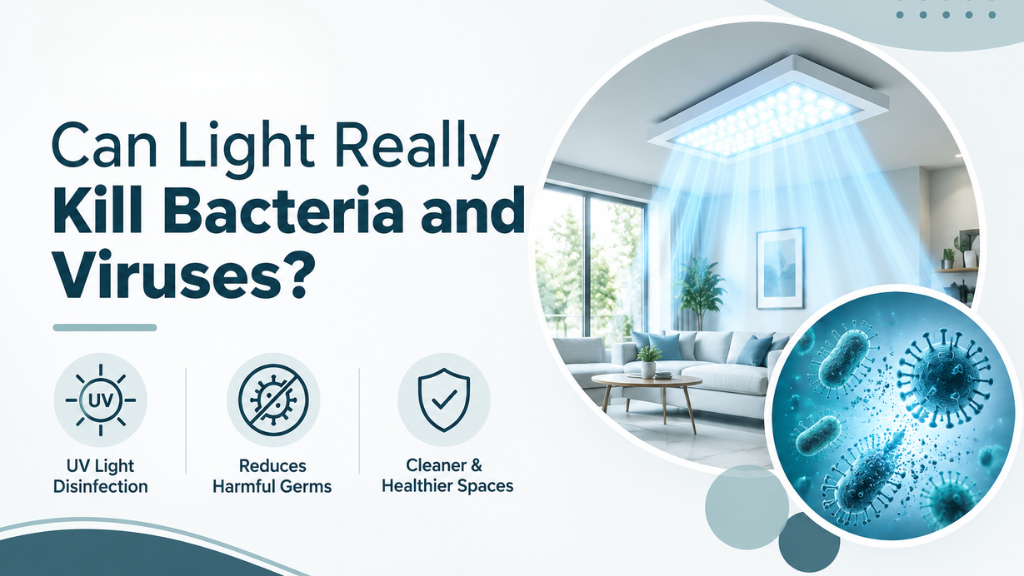
Yes, certain kinds of light can kill bacteria and some viruses. Two types do the work: ultraviolet (UV) light, and a specific band of visible violet-blue light near 405 nanometres.
Ordinary white light and warm infrared light do almost nothing to germs. So the honest answer is: some light kills germs, but not all light, and how well it works depends on the type of light and the germ.
This guide explains which light works, how it kills bacteria, whether it also stops viruses, and what light disinfection can and cannot do in a real room. The aim is to give you a clear, honest picture, without hype, so you can decide if it fits your home or business.
Curious whether antibacterial light would help your space? Ermen Systems for simple, honest advice.
Can light really kill germs?
It sounds surprising, but it is well established. People have known for over a hundred years that strong sunlight can reduce germs, mostly because of the UV in it.
The key point is that light carries energy. When the right kind of light meets a microbe, that energy can damage the cell so it can no longer grow or spread. Different wavelengths carry different amounts of energy, which is why one type of light can harm germs while another passes straight through them.
What matters is the type of light. Some parts of the light range act on germs, and most parts do not.
Hospitals have used this idea for a long time. Sunlit, airy wards were known to have fewer infections long before anyone understood why. Today we can copy that effect with the right lamps, indoors, all year round.
Which types of light kill bacteria?
There are two useful bands. UV light is the strongest germ-killer, but it is invisible and unsafe for skin and eyes. Violet-blue visible light near 405 nanometres is gentler, safe for people, and still able to reduce bacteria.
The white light from normal bulbs sits in between and has very little effect. Infrared, the warm light you feel from a heater, has none. So swapping to a brighter normal bulb will not clean your air; the wavelength is what counts, not how bright the light looks. The picture below shows where each type sits.
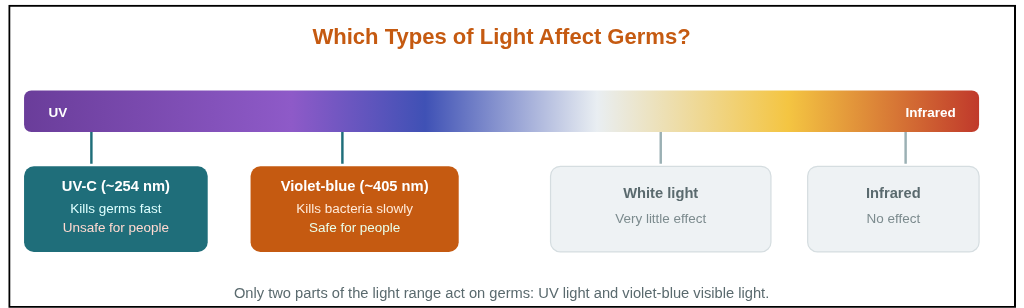
This is why safe, everyday antibacterial LED lighting uses the violet-blue part of visible light rather than UV. You get a germ-reducing effect without the risks that come with UV.
How does visible light kill bacteria?
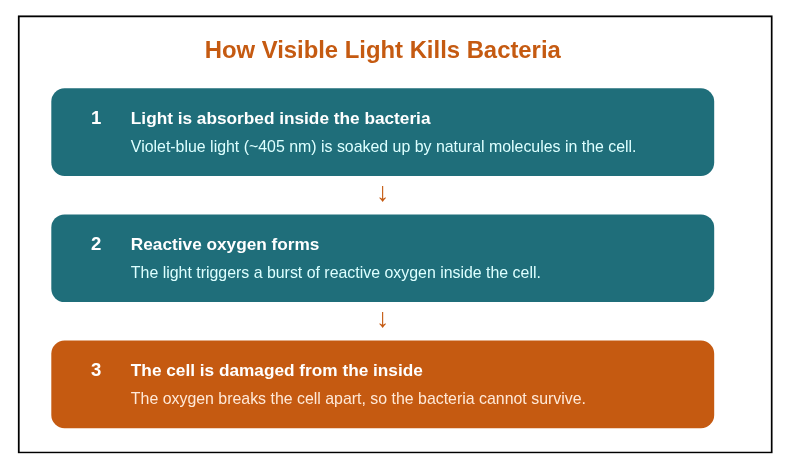
Bacteria contain natural molecules that soak up violet-blue light. When these molecules take in the light, they set off a small chemical reaction inside the cell.
That reaction creates reactive oxygen, a bit like a rust process, but very fast. The reactive oxygen then damages the bacteria from the inside until the cell breaks down. Because the germ cannot easily protect itself from this, it does not build up resistance the way it can with some cleaning products.
Because this happens inside the germ and not in human skin cells, the same light is safe for people while it steadily lowers the germ count. The steps are shown below.
Does UV light work on viruses like the flu or COVID?
Yes. UV-C acts on the genetic material inside a germ, and viruses carry the same kind of material as bacteria.
Independent research, including a study linked to the Icahn School of Medicine at Mount Sinai, has shown that the right light can deactivate viruses, including the one that causes COVID-19.
How well it works still depends on the dose, the distance and whether the light can actually reach the germ. Shaded or covered surfaces get little benefit.
Is UV light disinfection safe?
UV-C works well, but it is not gentle. The same energy that damages germ DNA also damages human skin and eyes.
Direct UV-C exposure can cause sunburn-like skin damage and painful eye irritation, sometimes within minutes. This is why standard UV-C can only run in sealed or empty spaces, with timers, cut-offs and warning signs.
Some UV-C lamps also make ozone, a gas that can irritate the lungs. Rooms often need airing before people go back in.
Need protection in rooms that are always busy, like clinics or classrooms? Talk to our team about a people-safe way to keep them clean..
The main limits of UV-C disinfection
Safety is the biggest issue, but it is not the only one. UV-C has a few practical limits that matter when you plan a real space.
-
It cannot be used around people, so the room must be empty.
-
It only cleans what the light can reach, so shadows and hidden spots are missed.
-
It works in short bursts, not all day, so germs can return between cycles.
-
Strong UV-C can fade and weaken plastics, fabrics and some finishes over time.
-
Some lamps make ozone and need extra ventilation.
For a theatre that sits empty at night, these trade-offs are fine. For a busy office, shop or school, they are much harder to manage.
A safer alternative: visible-light disinfection
There is another way to keep a space clean that does not carry the same risks. It uses visible light instead of UV.
Visible-light disinfection uses set frequencies of the light we can already see, often in the violet-blue range near 405 nanometres. This light is safe for skin and eyes at normal levels, so it can stay on while people are in the room.
It works more slowly than UV-C, but it never stops. Because the light is on for most of the day, it keeps working on surfaces and air the whole time the space is in use.
The Biovitae antibacterial lighting system is one example. It looks and works like a normal LED light, but it also lowers the bacterial count on surfaces and in the air while it runs. Because it is UV-free, there are no empty-room rules, no ozone and no special safety gear.
You can read more about the science on the Biovitae technology page.
Does light kill viruses too?
Light works best on bacteria and mould, which take in violet-blue light easily. Viruses are built a little differently, so visible light is usually slower and weaker against them.
That said, research has looked at this closely. A study linked to the Icahn School of Medicine at Mount Sinai found that certain light frequencies can deactivate viruses, including the one that causes COVID-19.
So the fair summary is this: light can reduce many viruses, but it is strongest against bacteria. For viruses, higher doses and longer exposure matter more.
This is why light works best as a steady, all-day layer rather than a quick fix. The longer the light is on, the more it can do against both bacteria and viruses in the room.
How long does antibacterial light take to work?
Visible antibacterial light is not instant. It lowers the germ count gradually over hours of use, not in a few seconds.
That is the trade-off for being safe around people. Instead of one strong blast, you get a gentle effect that runs the whole time the lights are on.
In practice this suits normal daily life well. A shop, ward or classroom keeps its lights on anyway, so the protection builds up through the day at no extra effort. You are not asked to change your routine; the light simply does its job in the background.
Is antibacterial light the same as UV disinfection?
No, and the difference matters. UV disinfection uses strong invisible light that damages a germ’s genetic code. It works fast, but it can burn skin and eyes, so rooms must be empty while it runs.
Antibacterial visible light is different. It uses safe, visible frequencies, so it can stay on all day while people are in the room. It is slower than UV, but it never has to stop, so the small effect adds up over many hours.
In short, UV is a fast clean for empty rooms, while visible light is steady protection for spaces that stay busy. Many people choose visible light for exactly that reason, and you can see why this kind of lighting suits everyday use.
What can antibacterial light do, and what can it not do?
It helps to be clear and realistic. Antibacterial light is a steady helper, not a magic switch.
What it can do:
-
Lower the number of bacteria on surfaces and in the air over time
-
Keep working safely while a room is in use
-
Run all day with no chemicals, filters or empty-room rules
-
Add a background layer of hygiene that never gets forgotten
What it cannot do:
-
Wipe out every germ the instant you switch it on
-
Replace normal cleaning, hand washing and good airflow
-
Reach germs that are hidden under objects or thick dirt
Used the right way, it works alongside your usual cleaning and gives a room a lower baseline of germs all the time. Think of it as a seat belt, not a reason to drive badly. It adds safety on top of the good habits you already have.
Where does antibacterial light help most?
It is most useful in spaces that stay busy for long hours, where you cannot keep clearing the room to clean it.
It suits homes and offices, where lights are on for much of the day. It is also a good fit for classrooms and childcare settings, where lots of children share the same space and bugs spread easily.
Care homes, gyms, waiting rooms and staff canteens are other good examples. Anywhere people gather for long periods, a quiet drop in the germ load is worth having.
Clinics, shops, kitchens and hospitality benefit too, since they mix lots of people, food or shared surfaces. You can get the light as bulbs, panels and batten fittings, so it drops into most rooms; the full range of Biovitae lights shows the options. In each case you keep normal, comfortable lighting and gain quiet, ongoing protection.
What should you look for in antibacterial lighting?
If you decide to try it, a few simple things help you choose well.
-
Light quality: it should look like normal, comfortable lighting.
-
Safety: it should be UV-free and safe for all-day use around people.
-
Fit: bulbs, panels or battens that match your existing fittings.
-
Proof: clear certification and independent testing behind the claims.
Good antibacterial lighting should feel ordinary to live and work under. The only difference you should notice is a room that stays a little cleaner over time, with no change to how it looks or feels. If a product promises to wipe out every germ in seconds, treat that claim with care, because real light disinfection is steady, not instant.
Frequently Asked Questions
It can reduce many viruses, but it works best on bacteria. Research has shown certain light can deactivate viruses, including the COVID-19 virus, at the right dose.
It can reduce many viruses, but it works best on bacteria. Research has shown certain light can deactivate viruses, including the COVID-19 virus, at the right dose.
Yes. Visible antibacterial light is UV-free and safe for people and pets at normal levels, so it can stay on while the room is in use.
Not really. Ordinary white light has very little effect. You need the special violet-blue frequencies for a real germ-reducing result.
To a point, yes, mainly because sunlight contains UV. But it is not reliable indoors, where most surfaces get little direct sun.
Conclusion
The right type of light can help reduce germs and provide an extra layer of protection in everyday spaces. While UV light works quickly, visible antibacterial light can operate continuously around people. It should complement, not replace, regular cleaning and good ventilation. Ermen Systems provides antibacterial lighting solutions designed to support cleaner, healthier environments.
