Latest Blog
Why Indoor Air Quality Monitoring Matters in Commercial Buildings
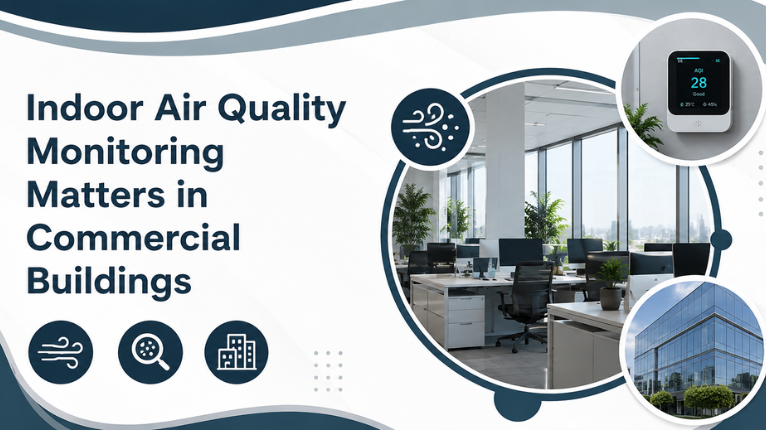
In today’s commercial environments, air quality is no longer a background concern; it is a measurable factor that directly influences health, productivity, and building performance. Commercial indoor air quality plays a critical role in how people feel and function inside offices, retail spaces, hospitals, and educational buildings.
Poor air circulation, elevated CO₂ levels, and unseen pollutants can quickly turn a modern workspace into an unhealthy environment. In Ireland and across the UK, businesses are increasingly recognising that maintaining proper indoor air standards is essential not only for employee wellbeing but also for compliance and operational efficiency.
Monitoring air quality helps building managers identify issues early, improve ventilation performance, and create safer, more productive workplaces.
What Is Commercial Indoor Air Quality?
Commercial indoor air quality refers to the condition of the air inside business buildings and its effects on occupants. It includes factors such as temperature, humidity, CO₂ levels, airborne particles, and chemical pollutants.
Unlike residential spaces, commercial environments face higher occupancy levels, longer exposure times, and more complex HVAC demands. This makes continuous monitoring essential rather than optional.
Why It Matters For Modern Workplaces
Improve workplace air quality with tailored ventilation and monitoring solutions.
Workplaces with poor air quality often experience:
- Reduced employee concentration
- Increased absences
- Higher fatigue levels
- Declining overall productivity
Studies consistently show that improved air conditions lead to better cognitive performance. In commercial settings, even small improvements in air quality can result in noticeable gains in efficiency and employee satisfaction.
The Link Between Ventilation Systems And Air Quality
A building’s air quality is directly tied to its ventilation systems. If airflow is restricted, outdated, or poorly maintained, pollutants accumulate quickly.
Modern ventilation systems are designed to:
- Circulate fresh air efficiently
- Remove contaminants
- Balance humidity levels
- Support energy efficiency goals
However, without monitoring, even a well-designed system can underperform unnoticed.
This is where commercial ventilation strategy becomes essential: ensuring airflow is not just present, but effective.
Commercial Ventilation Challenges In Modern Buildings
Modern energy-efficient buildings in Ireland are often tightly sealed to reduce heat loss. While this improves energy savings, it can trap stale air inside.
Essential challenges include:
- Reduced natural airflow
- Build-up of CO₂ and VOCs
- Inconsistent temperature distribution
- Overworked HVAC systems
Without proper oversight, these issues quietly affect workplace conditions and operational efficiency.
Understanding Sick Building Syndrome
Sick Building Syndrome refers to situations where many people experience health issues linked to time spent inside a building, with no clear medical cause.
Symptoms may include:
- Headaches
- Eye irritation
- Fatigue
- Difficulty concentrating
The root cause is often linked to poor ventilation and uncontrolled indoor pollutants.
For business owners, this translates into:
- Lost productivity
- Higher sick leave
- Potential reputational risk
How Poor Ventilation Affects Productivity
Poor airflow does more than make a space uncomfortable; it directly impacts how people work.
When ventilation is insufficient:
- Oxygen levels drop
- CO₂ levels rise
- Mental performance decreases
Employees may not immediately notice the cause, but the business feels the impact through slower output and reduced efficiency.
Benefits Of Air Quality Monitoring Systems
Installing monitoring systems gives businesses real-time visibility into indoor conditions.
Essential benefits include:
- Early detection of ventilation issues
- Improved energy efficiency
- Better compliance with workplace health standards
- Reduced maintenance costs through predictive insights
- Healthier, more productive employees
For decision-makers, this means fewer surprises and more control over building performance.
Essential Measures Businesses Should Track
Effective monitoring focuses on measurable indicators:
- CO₂ concentration
- Humidity levels
- Temperature stability
- Particulate matter (PM2.5/PM10)
- Air exchange rates
Tracking these metrics helps identify when ventilation systems need adjustment or servicing.
How Commercial Air Quality Monitoring Is Implemented

The process usually follows a structured approach:
- Assess current ventilation systems and airflow performance
- Identify problem zones with poor circulation
- Install indoor air quality sensors across key areas
- Connect monitoring data to building management systems
- Adjust ventilation rates based on real-time readings
- Continuously review performance and optimize settings
This approach ensures commercial buildings in Ireland maintain consistent air quality without unnecessary energy consumption.
Frequently Asked Questions
It refers to air conditions inside commercial buildings, including CO₂, humidity, temperature, and pollutants that affect health and comfort.
It impacts employee health, focus, and productivity. Poor air quality can increase sickness and reduce performance.
Main causes include poor ventilation, overcrowding, and poorly maintained HVAC systems.
It is when people feel unwell in a building due to poor air quality or ventilation issues.
They control airflow and remove pollutants. Poorly maintained systems can worsen air quality.
CO₂ levels, humidity, temperature, VOCs, and airborne particles.
Final Thoughts
Explore reliable commercial air quality and ventilation solutions from Ermen Systems.
Indoor air quality is no longer a background facility concern; it is a business performance factor. For commercial spaces in Ireland, monitoring air conditions ensures healthier employees, better productivity, and more efficient building operations. When combined with properly maintained ventilation systems, it reduces risks linked to sick building syndrome and poor ventilation. Business owners who prioritise air quality are ultimately investing in stronger performance and long-term operational stability.
Improve Workplace Air Quality With Smarter Monitoring Solutions Today
Take control of your building’s air quality and enhance workplace performance with expert solutions from Ermen Systems. Discover smarter monitoring approaches designed to improve efficiency, health, and compliance across commercial environments.
