Latest Blog
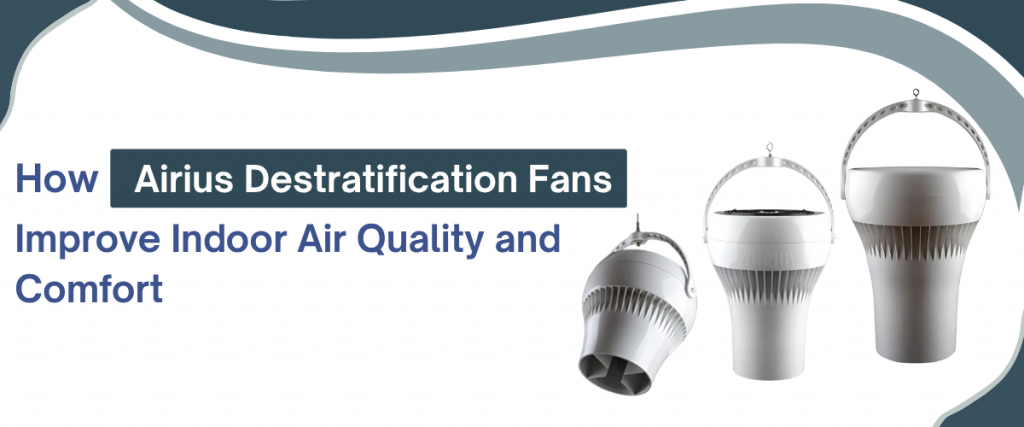
How Airius Destratification Fans Improve Indoor Air Quality and Comfort
Every modern building owner or facility manager understands the balance they must strike between thermal comfort, indoor air quality, and energy efficiency. But even with a well-sized HVAC system, many large or tall interior spaces suffer from heat stratification, where warm air rises and accumulates near the ceiling, leaving the occupied zones cooler. This creates cold or draughty spots and drives up energy use.
In recent years, destratification fans have emerged as a powerful but under-utilised tool to correct this imbalance. Among them, Airius destratification fans stand out for their engineered air mixing and efficiency. In this blog, we explore how Airius destratification fans improve indoor air quality and comfort, and how HVAC solutions deliver better environments and cost savings.
Table of Contents

How Airius Destratification Fans Improve Indoor Air Quality and Comfort |
What Is Heat Stratification and Why Does It Matter
Thermal or heat stratification is the natural process by which warm, lighter air rises and cool air sinks. In high ceilings, warehouses, gymnasiums, or large halls, this leads to a vertical temperature gradient: the ceiling zone can be several degrees warmer than the floor.
This stratification causes multiple challenges:
- To keep floor-level occupancy zones comfortable, heating systems often overcompensate, overheating the upper zones (wasting energy).
- Cold spots or discomfort near workstations or seating zones.
- Stagnant air or poor circulation in portions of the space may degrade air quality.
- In cooling mode, similar issues can occur where cooled air fails to reach ceiling zones or becomes trapped.
Correcting stratification is therefore crucial for both comfort and efficiency.
How a Destratification Fan Works
A destratification fan is not a traditional ceiling fan; rather, it is designed to create a gentle but effective column of air from ceiling to floor. It continuously mixes air in the space, breaking up stratified layers so that warm and cool air are redistributed evenly.
Key mechanics include:
- Vertical air column: The fan draws warmer upper-air down in a focused column, rather than blowing broadly and creating drafts.
- Mixing, not gusts: The airflow is slowly circulated to prevent a “windy” feel but gradually equalises temperature differences.
- Continuous operation: These fans typically operate at a base speed (or modulate) to maintain balance, not just when intervention is needed.
When properly sized and installed, the destratification fan equalises air temperature from ceiling to floor, reducing the need for excessive heating or cooling.
How Destratification Fans Improve Indoor Air Quality
While their primary role is thermal equalisation, destratification fans also yield several air-quality benefits:
1. Improved air circulation
Stratified zones often harbor stagnant air pockets, which allow pollutants, CO₂, or allergens to linger. Destratification helps move those pollutants into the general airflow where HVAC filters or ventilation systems can more effectively remove them.
2. Reduced humidity and condensation risk
Better mixing helps equalise moisture levels, preventing condensation on upper surfaces and reducing damp zones that foster mould growth.
3. Supporting HVAC ventilation performance
By reducing temperature gradients, destratification fans allow supply air (from AHUs, VAVs, etc.) to entrain and mix with interior air more evenly, leading to a more homogeneous distribution of fresh air and better dilution of indoor contaminants.
4. Option for active disinfection (via Airius PureAir)
The PureAir series from Airius integrates ionization technology (NPBI) that can inactivate viruses, bacteria, mould spores, and VOCs in the passing airflow. This adds a layer of indoor air purification integrated within the destratification function.
Thus, destratification fans play a dual role: improving thermal comfort and contributing to healthier indoor air.
Key Considerations for Implementation
When planning to integrate destratification fans into a building, keep these points in mind:
- Ceiling height and layout: Destratification actually offers more benefit in spaces with high ceilings (e.g., 5 m and above).
- Fan sizing and throw: Use velocity profiles (not just CFM) to size fans so that their air column reaches the occupied zone without excessive dispersion.
- Control strategy: Use thermostatic or delta-T sensors; integrate with BMS (BACnet or similar) for intelligent modulation.
- Noise thresholds: In office or retail areas, choose quieter models (e.g., Onyx or Q series) to avoid disturbing the ambient environment.
- Electrical and safety standards: Ensure compliance with UK wiring regs, mounting safety cables, and a suitable power supply (230V / 50 Hz).
- Maintenance & monitoring: Periodic checks of motor, wiring, dust accumulation, and, if using purification modules, ensure proper cleaning or upkeep.
Conclusion
In the pursuit of energy efficiency, occupant comfort, and healthier indoor air, destratification fans offer a compelling, relatively low-invasion solution. By mitigating heat stratification, promoting continuous air mixing, and in some cases delivering active air purification, they bridge the gap between heating, ventilation, and air quality in a cost-effective way.
If you’re curious how a destratification fan system would perform in your facility, or want a tailored specification for your next HVAC or IAQ upgrade, Ermen Systems is ready to help.